MICAPP
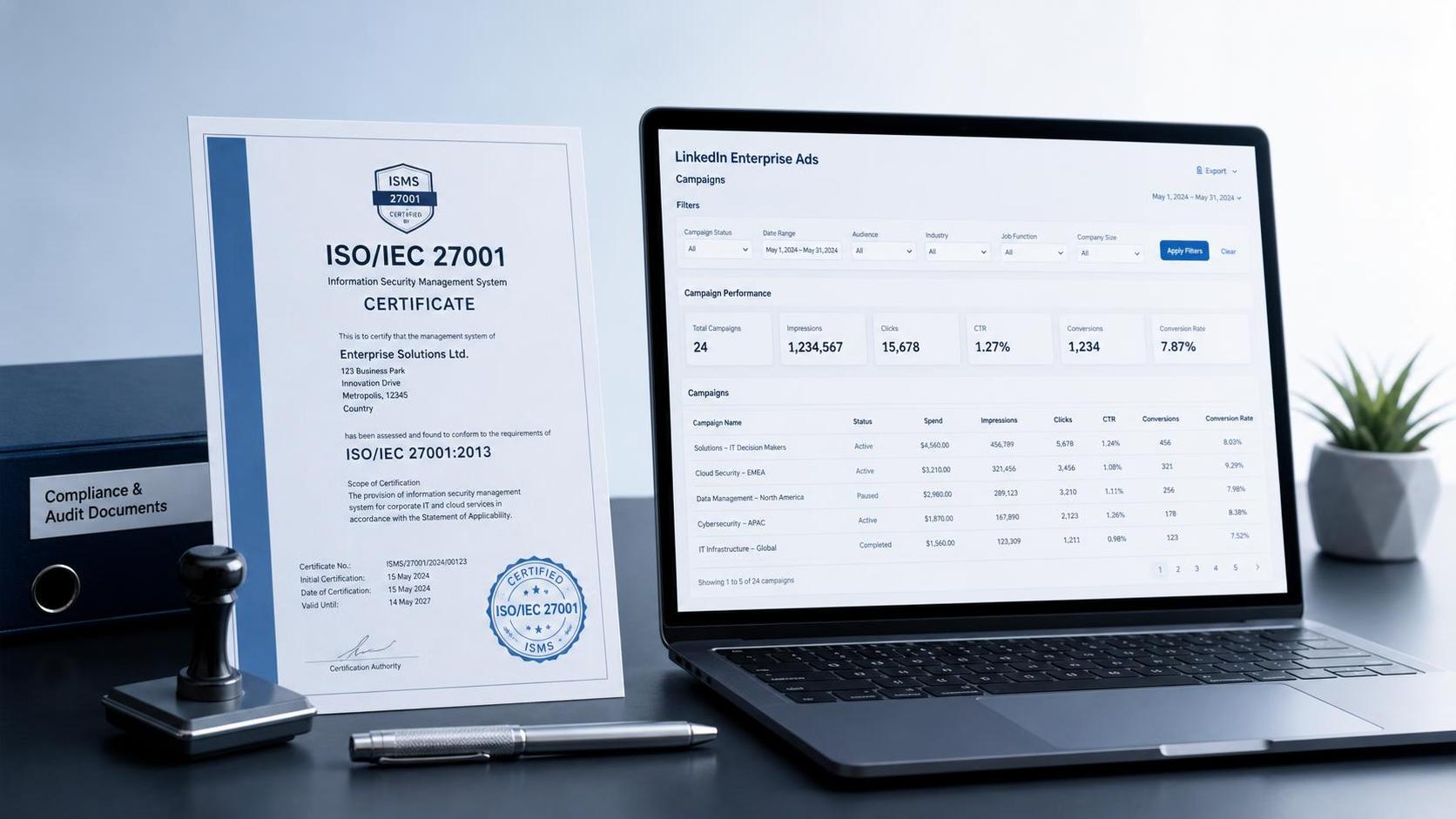
On August 9, 2026, LinkedIn updated its Global Ad Eligibility Policy and immediately introduced a new requirement for China-registered B2B advertisers targeting EMEA and Latin America: a valid ISO/IEC 27001 certification must be uploaded to access advanced options such as job matching, company size filtering, and technology stack targeting. For Chinese SaaS companies that rely on LinkedIn to reach overseas channel partners and distributors, this is worth close attention because it directly affects how precisely they can run partner acquisition and market expansion campaigns.
What the policy update now requires
According to the provided event information, LinkedIn revised its Global Ad Eligibility Policy on August 9, 2026. From that date, if a B2B advertiser is a company registered in China and is targeting markets in EMEA or Latin America, it must submit a valid ISO/IEC 27001 information security management system certification. Without that certification, the advertiser cannot enable advanced B2B targeting functions including job matching, company size filters, and technology stack targeting.
The same provided information also states that this change materially affects the ability of Chinese SaaS providers to reach overseas channel partners and distribution partners through LinkedIn advertising.
Where the business impact is likely to appear first
Chinese SaaS vendors pursuing overseas partner growth
Analysis shows this group is the most directly exposed because the restricted functions are described as high-value B2B targeting tools. If those tools are unavailable, the affected stage is not general brand visibility alone, but more specifically the precision layer of partner outreach, especially where advertisers need to identify decision-makers, company profiles, or relevant technical environments.
What deserves closer attention is whether current campaigns aimed at EMEA and Latin America depend heavily on role-based, company-size, or technology-stack segmentation. Where they do, the immediate operational effect may be felt in targeting design and lead qualification.
Channel development and distribution-facing marketing teams
From an industry perspective, teams responsible for recruiting resellers, distributors, or regional partners may also feel the impact quickly. The reason is straightforward: the affected LinkedIn functions are closely tied to narrowing audience selection for business partnership scenarios. The main pressure point is campaign execution, particularly in identifying and reaching the right counterpart within target organizations.
These teams should pay attention to whether partner acquisition workflows in EMEA and Latin America have become dependent on LinkedIn's advanced filters as a routine part of outbound digital marketing.
Advertising service providers and campaign operators
Observably, agencies, demand generation teams, and in-house campaign operators serving China-registered SaaS companies may need to adjust compliance checks before launch. The issue is not merely media buying access, but whether a campaign can actually use the targeting depth expected for B2B lead generation. The relevant business link here is campaign setup, audience architecture, and client communication around qualification requirements.
What they need to monitor is whether certification availability becomes a gating item in planning, approval, and delivery timelines for cross-border B2B campaigns.
What companies should watch now
Whether certification status can support ongoing campaign needs
Analysis shows the first practical question is whether a China-registered advertiser already holds a valid ISO/IEC 27001 certification that can be uploaded under LinkedIn's updated requirement. This matters because the policy is described as taking effect immediately, and the issue is tied directly to access to advanced targeting functions rather than to a distant future deadline.
How much current EMEA and Latin America activity depends on advanced targeting
What deserves closer attention is the degree of operational dependence on job matching, company size filtering, and technology stack targeting. Companies with limited use of these features may experience a narrower effect, while those that built campaign logic around them should review exposure at the market, product, and partner-development level.
The gap between policy wording and campaign execution
Observably, there can be a difference between a formal platform rule and how that rule affects daily advertising operations. The confirmed fact here is the eligibility condition tied to advanced targeting. The point that still requires business-side verification is how existing account structures, launch schedules, and audience plans are altered in practice once certification is absent or pending.
Documentation and cross-team communication
From an industry perspective, companies should also focus on internal readiness around qualification documents and external communication with marketing operators or overseas growth teams. Where account execution involves multiple stakeholders, certification status and submission readiness can become a coordination issue rather than just a compliance checkbox.
Why this looks like more than a minor platform adjustment
This section is an editorial observation. Analysis shows the update is best understood as a targeted eligibility change with immediate commercial relevance for a specific advertiser group: China-registered B2B companies seeking advanced LinkedIn targeting in EMEA and Latin America. The significance lies less in the existence of a new document requirement by itself and more in the fact that the requirement is attached to precision tools that matter in SaaS partner acquisition.
It is more appropriate to understand this as both a short-term operational change and a longer-term signal worth monitoring. The short-term element is clear because access to advanced targeting is said to depend on certification from the effective date. The longer-term signal is that platform-level eligibility rules may increasingly shape cross-border B2B customer and partner acquisition through compliance-linked conditions. At the same time, any broader conclusion beyond this specific rule still needs continued observation.
How to read the development at this stage
At this stage, the update should be read as a concrete rule change with direct implications for campaign precision rather than as a complete redefinition of overseas digital marketing for Chinese SaaS firms. The confirmed impact is centered on access to advanced B2B targeting for eligible advertisers in specified regions. The broader business outcome will depend on how heavily individual companies rely on those functions in reaching channel and distribution partners.
A neutral conclusion is that this is not just a routine wording update, but it is also too early to generalize beyond the scope described in the provided information. For now, it is more appropriate to treat the development as a compliance-linked market access signal inside LinkedIn's B2B advertising workflow, with practical importance for affected SaaS businesses.
Basis of this article and what still needs verification
This article is based on the user-provided news title, event date, and event summary. The confirmed factual basis used here is limited to the reported August 9, 2026 policy update by LinkedIn, the stated ISO/IEC 27001 requirement for China-registered B2B advertisers targeting EMEA and Latin America, and the stated restriction on advanced targeting features where certification is not provided.
For this type of development, commonly relevant source categories would include official platform policy announcements, company statements, industry association materials, authoritative media reporting, and standards-related documents. A specific official source link was not provided in the input, so the exact wording and any later clarifications still require ongoing verification. Continued attention should focus on whether LinkedIn issues additional guidance on implementation details, scope, or subsequent policy adjustments.