MICAPP
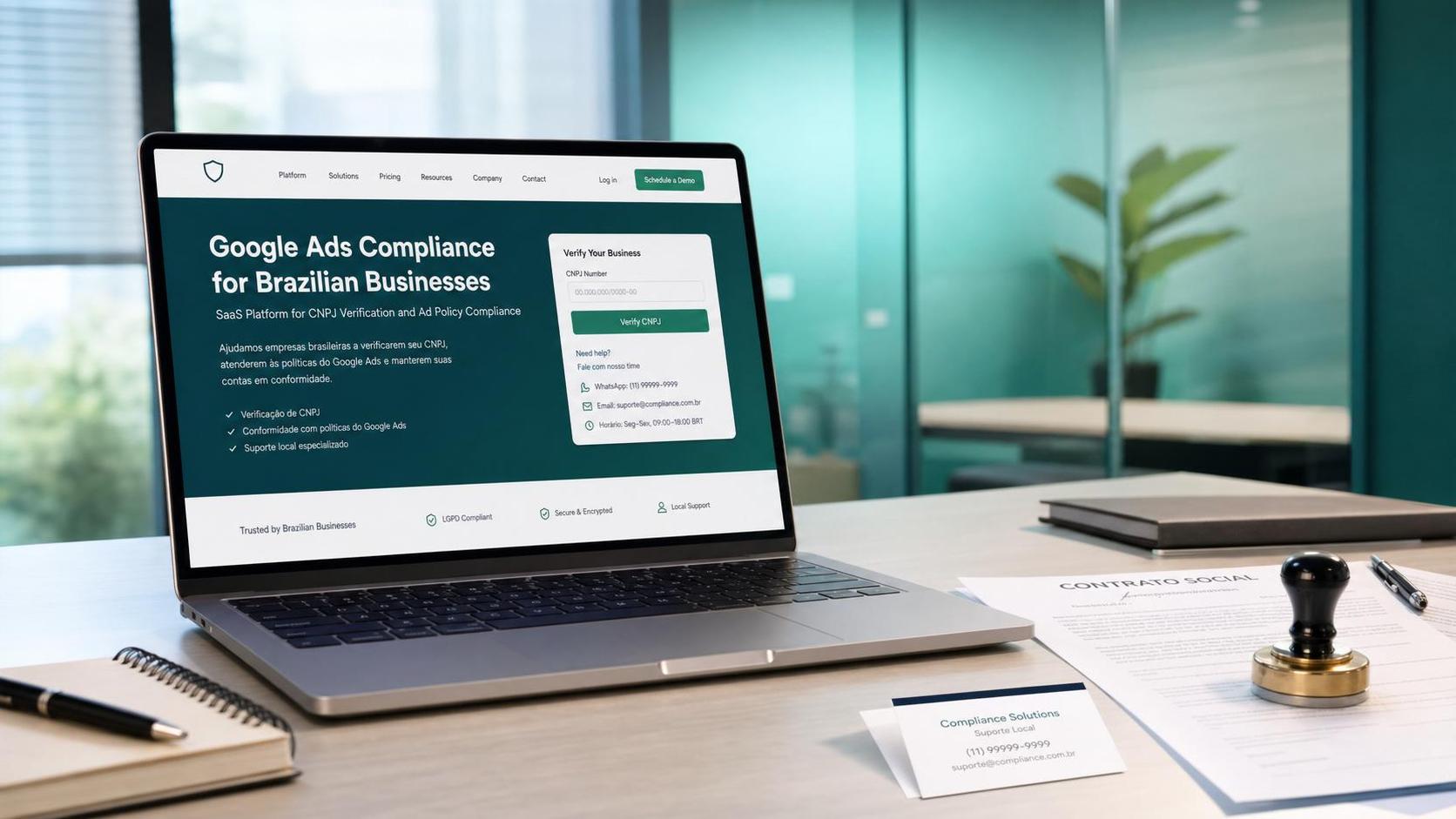
On July 18, 2026, Google began enforcing a new ad review rule in Brazil that directly affects advertisers targeting Brazilian users. The change requires ads and landing pages to present Portuguese-language localized content, a Brazilian tax registration number (CNPJ), and local customer service contact details. For Chinese companies using SaaS website-building and ad delivery workflows for the Brazil market, this is worth close attention because the rule now connects ad approval and traffic access more directly to landing-page compliance.
What the Rule Now Requires for Brazil-Facing Ads
According to the provided event summary, Google is mandating new review requirements for ads aimed at users in Brazil from July 18, 2026. The confirmed requirements are that the advertising content and landing pages must include Portuguese localization, a CNPJ, and local customer service contact information.
The same summary states that pages that do not meet these requirements may face traffic restrictions or ad disapproval. It also confirms that the change has a direct effect on the advertising compliance and conversion performance of Chinese SaaS website-building customers operating in the Brazil market.
Where the Operational Pressure Is Likely to Appear First
Landing-page providers and site delivery teams
From an industry perspective, the first impact falls on teams responsible for building and updating localized landing pages. The reason is straightforward: the new review standard does not stop at ad copy and extends to the destination page itself. For these providers, the affected business steps are page deployment, localized content preparation, contact-information display, and compliance checks before campaign launch. What deserves closer attention is whether current page templates, approval flows, and client onboarding materials already support the required Brazil-facing fields.
Export-oriented advertisers targeting Brazilian demand
For export-oriented businesses using Google Ads to acquire customers in Brazil, the main pressure point is campaign continuity. If landing pages do not contain the required Portuguese content, CNPJ, and local service contact details, advertising traffic may be restricted or campaigns may not pass review. In practice, that makes compliance review part of customer acquisition rather than a separate legal formality. Teams handling paid traffic, market entry, and lead generation therefore need to treat page compliance as a delivery prerequisite.
SaaS service firms serving cross-border clients
Chinese SaaS companies that provide website-building, page hosting, or campaign support may also feel the impact through client service obligations. Analysis shows the issue is not only whether their own marketing meets the rule, but whether their product workflows can help customers publish compliant Brazil-focused pages quickly. The affected links include template configuration, account setup, client documentation collection, and post-launch troubleshooting when ads are limited or rejected.
Customer service and after-sales support functions
The new requirement for local customer service contact details also pulls support functions into the compliance chain. Observably, this means that ad operations, website content, and customer contact arrangements can no longer be handled in isolation. Businesses serving Brazil need to pay attention to whether their support presentation on the landing page matches the review expectation closely enough to avoid avoidable delays in campaign approval.
What Companies Should Check Now
Review whether Brazil-facing pages are truly localized
Analysis shows that simple translation fragments may not be enough if the page as a whole does not clearly present Portuguese-language localized content. Companies should therefore check the actual landing-page experience used in Brazil campaigns rather than reviewing ad copy alone.
Verify whether required identity and contact elements are present
What deserves closer attention is the visibility and consistency of the CNPJ and local customer service contact details on the destination page. Because the provided summary confirms these as required items, businesses should examine whether they are already included in active campaign pages and whether updated versions are reflected across all ad-linked URLs.
Align ad review preparation with campaign launch timing
For teams managing media buying or market rollout schedules, this rule change should be treated as part of launch readiness. Observably, a page that is commercially ready but not review-ready can still disrupt lead generation if traffic is restricted or the ad is disapproved. That makes internal handoff between content, legal or compliance review, and ad operations more important in the current stage.
Keep watching for execution language and market feedback
The provided information confirms the rule and its effective date, but it does not provide detailed enforcement examples or broader implementation guidance. Companies should therefore continue monitoring official wording, review outcomes, and market feedback before assuming that one formatting approach or one page structure will consistently satisfy review in every case.
Why This Looks More Like an Enforcement Signal Than a Routine Update
This section is an observation rather than a statement of fact. It is more appropriate to understand this development as an execution signal tied to market-facing compliance in digital customer acquisition. The reason is that the rule links formal page elements, localized communication, and advertiser identity information directly to ad approval outcomes. For companies operating across borders, that shifts part of compliance from back-office documentation into the visible sales and conversion layer.
At the same time, it should not yet be overstated beyond the confirmed facts. The provided information does not establish broader policy spillover, detailed review thresholds, or final market response. Observably, the immediate significance lies in the fact that the requirement is already in force and can affect campaign access if ignored.
How This Update Is Best Understood at This Stage
At this stage, the event is best read as a live compliance requirement for Brazil-targeted Google Ads activity rather than a distant policy discussion. Its practical meaning is narrow but concrete: advertisers and service providers involved in Brazil-facing campaigns need to ensure that landing pages match the new review conditions. Analysis shows the most relevant takeaway is not a broad market prediction, but the need to connect localization, business identity display, and customer contact presentation with campaign delivery planning.
Basis for This Article and What Still Needs Verification
This article is generated based on the user-provided news title, event date, and event summary. For events of this type, commonly relevant source categories may include official platform announcements, regulatory notices, trade or customs authority updates, industry association communications, standards-related documents, and reporting by established business media. No specific official source link was provided in the input, so that part still requires ongoing verification.
Further observation is still needed on any subsequent clarification of review language, enforcement interpretation, market feedback, and how companies adjust their execution practices after the rule takes effect. Those points should be tracked separately from the confirmed facts summarized above.