MICAPP
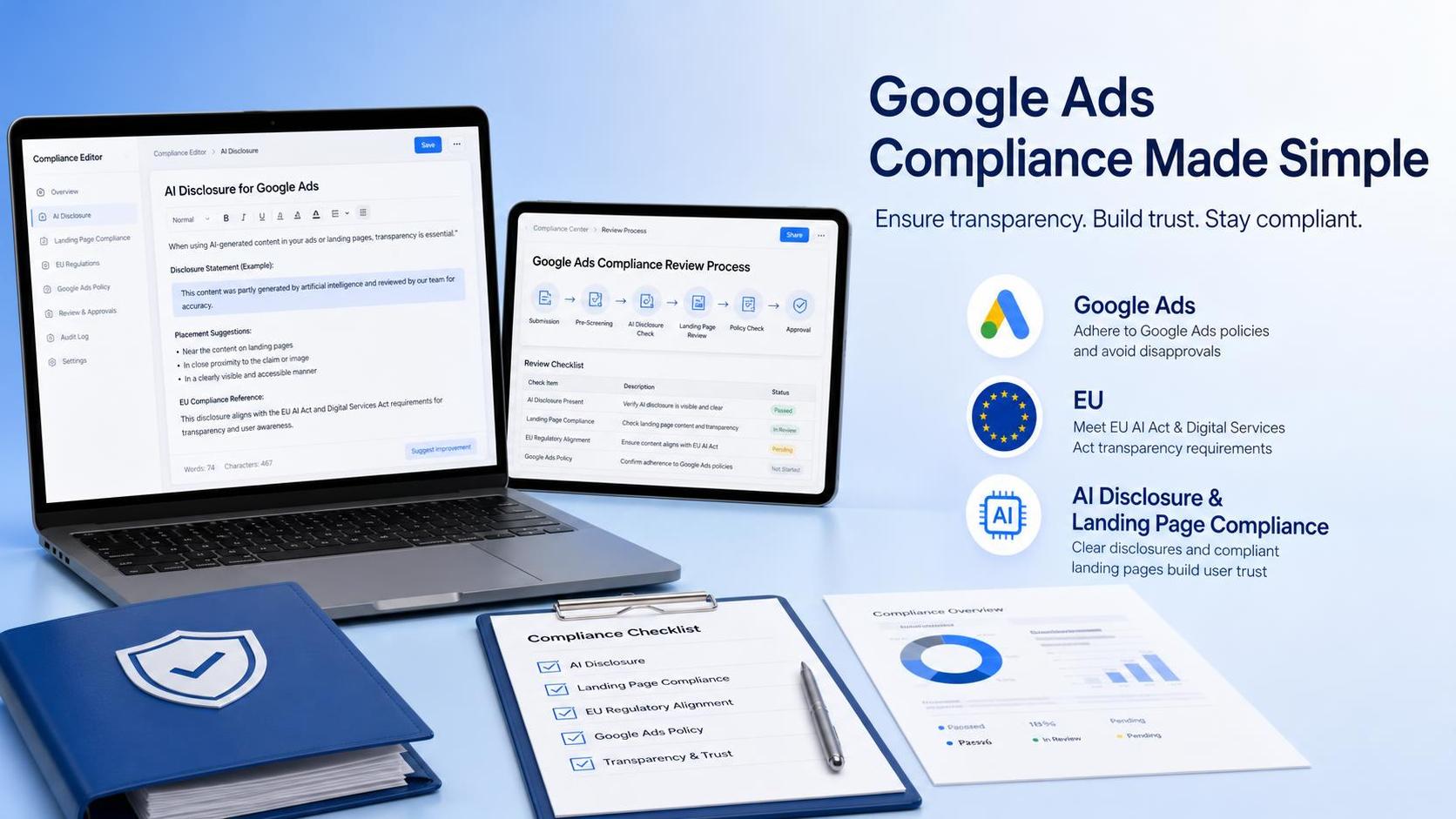
On July 22, 2026, a new compliance requirement takes effect for advertisers using Google Ads in the EU market: landing pages must display a prominent disclosure when content is AI-generated. For independent-site businesses, including China-based exporters serving EU customers through Google advertising, this is not just a platform rule update but a practical compliance checkpoint tied to the implementation rules of the EU AI Act. It deserves attention because the consequence is immediate at the traffic and account-review level, which means marketing delivery, campaign continuity, and site operations may all be affected at the same time.
What Has Been Confirmed as of July 22, 2026
The confirmed facts are limited but clear. From July 22, 2026, Google Ads requires advertisers targeting the EU market to place a visible AI-generated content disclosure on their ad landing pages. If that disclosure is missing, automated traffic restriction and account review may be triggered. The requirement is stated to follow the implementing rules of the EU AI Act. It applies to independent-site customers using the Maikaipu cloud intelligent website-building system to run Google advertising.
Where the Operational Impact Is Likely to Appear First
Independent-site exporters selling through paid traffic
From an industry perspective, exporters that rely on Google Ads to reach EU buyers may feel the effect first because the rule is connected directly to traffic access and account review. The practical issue is not only whether ad creative uses AI-generated material, but whether the landing page presents the required disclosure in a visible way. For these businesses, the affected link in the chain is campaign delivery, page compliance review, and day-to-day account stability.
Website operation and content production teams
Observably, this change also shifts responsibility to teams managing landing pages, product copy, and visual presentation. If AI-assisted text, images, or page elements are part of the content workflow, those teams may need to check whether disclosure language is present and placed prominently enough to satisfy the rule. The key concern here is page-level compliance execution rather than a purely advertising-side adjustment.
Service providers supporting ad launch and site deployment
For service providers involved in site setup, campaign launch, and page updates, the rule may introduce an additional compliance review step before delivery goes live. What deserves closer attention is whether project handover, page acceptance, and ongoing maintenance now need a clearer division of responsibility around AI disclosure, especially for customers using a website-building system connected to Google Ads operations.
What Companies Should Check Now
Review whether landing-page disclosure is built into the release process
Analysis shows that the most immediate task is procedural. Companies should check whether pages used for EU-targeted Google Ads have a release checkpoint for visible AI-generated content disclosure. The rule described in the event summary points to page presentation as the critical compliance surface.
Separate confirmed requirements from internal assumptions
Because the input does not provide fuller execution details, companies should avoid treating internal interpretations as settled policy. It is more appropriate to understand the current change as a confirmed disclosure requirement with confirmed enforcement consequences, while keeping room to verify exact wording, display standards, and any future clarification in platform or regulatory guidance.
Check coordination between ad teams and site teams
What deserves closer attention is cross-functional coordination. If ad operations, compliance review, and website editing are handled by different teams or vendors, the risk is that campaigns go live before the landing page meets the disclosure requirement. Businesses targeting the EU market should therefore pay attention to workflow alignment rather than focusing only on ad account settings.
Track whether account review affects delivery timing
Observably, the stated consequence of automated traffic restriction and account review means companies should monitor execution timing, especially where paid acquisition is tied to product launches, seasonal sales, or distributor support. The input does not confirm how long reviews may take, so this remains a point for operational monitoring rather than a fixed conclusion.
Why This Looks Like an Execution Signal, Not Just a Policy Reference
Analysis shows that this development is better read as an execution signal than as abstract policy discussion. The rule links an EU AI compliance concept to a specific platform behavior: visible disclosure on the landing page, with delivery restriction and account review as direct consequences. That makes the change more concrete for the market than a general regulatory reference alone. At the same time, it would be premature to infer broader enforcement outcomes beyond what has been explicitly stated in the input.
From an industry perspective, the main value of this signal is that compliance expectations are moving closer to the live commercial interface seen by users. Businesses that treat AI use only as an internal content-production issue may need to reconsider that assumption when ad distribution depends on visible disclosure at the page level.
How This Update Is Best Understood at Present
At this stage, the update is best understood as a rule already entering practical enforcement for relevant Google Ads activity in the EU market on July 22, 2026. The confirmed change is narrow but operationally meaningful: a landing-page disclosure requirement tied to AI-generated content, backed by automated delivery limits and account review. A measured reading is more appropriate than a broad one. The immediate significance lies in compliance execution for advertising-linked pages, while wider market effects still need to be observed through follow-up guidance and implementation feedback.
Basis of This Article and What Still Needs Verification
This article is based on the user-provided news title, event date, and event summary. For developments of this kind, relevant source categories would typically include official platform announcements, regulatory publications, trade or supervisory authority notices, industry association updates, standards documents, and reporting by established business media. No specific official source link was provided in the input, so the exact official reference should continue to be verified. Further observation is still needed on implementing details, enforcement interpretation, platform wording, market feedback, and how companies are executing the requirement in live campaigns.