MICAPP
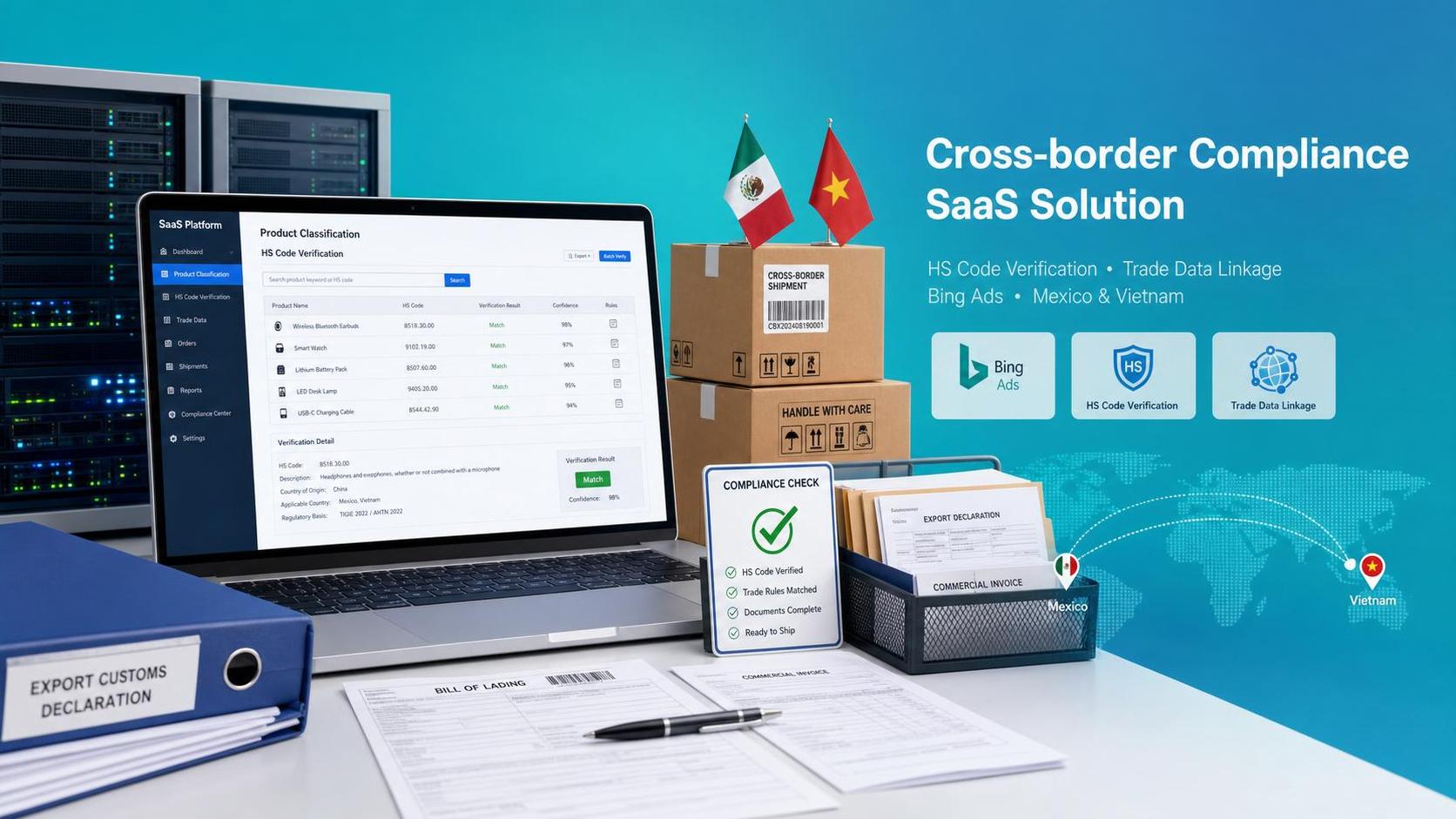
On July 14, 2026, Bing Advertising opened global public testing for HS Code intelligent validation tool v2.3, adding real-time matching against the customs code libraries of Mexico SAT and Vietnam VNACCS. The update matters because it ties advertising-driven export activity more directly to customs classification compliance, especially for Chinese exporters using the Maikaipu system to connect with Bing Advertising for Latin American and Southeast Asian markets. For companies managing cross-border sales, customs documents, and delivery schedules, the practical issue is not only tool availability, but the growing expectation that product classification accuracy must be checked earlier in the trade workflow.
What the v2.3 rollout confirms
The confirmed facts are limited but commercially relevant. Bing Advertising launched global public testing of HS Code intelligent validation tool v2.3 on July 14, 2026. The new version adds real-time matching with the customs code libraries of Mexico SAT and Vietnam VNACCS. According to the provided event summary, the tool can automatically identify classification deviations and compliance risks for Chinese export goods when declared in those two markets. The same summary states that the upgrade helps reduce customs clearance delays and tariff disputes caused by HS code errors, and that it is particularly useful for small and medium-sized export enterprises using the Maikaipu system to connect with Bing Advertising in Latin American and Southeast Asian business expansion.
Where the rule signal reaches across operations
Export-facing sales workflows are moving closer to customs review logic
From an industry perspective, exporters that acquire overseas demand through digital advertising may be affected first because product promotion, order intake, and customs declaration are no longer fully separate steps in practice. If a tool can identify classification deviations before shipment, the business impact is likely to appear in product listing preparation, internal SKU mapping, quotation review, and pre-declaration document checks. What deserves closer attention is whether teams have consistent HS code records across marketing descriptions, commercial documents, and customs submissions.
Supply chain and fulfillment teams may need tighter document coordination
Observably, the main pressure for supply chain service providers and fulfillment teams is not a new legal obligation stated in the input, but a stronger compliance checkpoint inside the export process. Where product classification errors can trigger clearance delays or tariff disputes, operations teams should pay closer attention to the consistency of shipment data, product descriptions, and declaration materials used for Mexico and Vietnam. The operational effect may be felt most in handoff points between sales, logistics, and customs-related documentation.
SME exporters gain a practical screening layer, but not a substitute for compliance judgment
For small and medium-sized exporters, especially those using the Maikaipu system to connect with Bing Advertising, the update may reduce avoidable errors at an earlier stage. Analysis shows that this is most relevant for businesses that do not maintain large in-house trade compliance teams and therefore depend on tools to flag classification mismatches before they become delivery or duty disputes. Even so, companies should treat automated matching as a risk-screening aid rather than as a final compliance determination, because the input does not state that the tool replaces official customs decisions.
What companies should watch in day-to-day execution
Check whether internal product data can support cleaner classification
Analysis shows that companies should first look at the quality of their own product data. If descriptions, specifications, and SKU records are incomplete or inconsistent, real-time comparison against customs code libraries may identify problems without resolving them. The immediate task is to confirm whether internal materials used for export declarations are aligned well enough to support more accurate classification review.
Review how trade documents are prepared for Mexico and Vietnam
What deserves closer attention is the documentation chain for shipments into the two referenced markets. The event summary confirms real-time matching with Mexico SAT and Vietnam VNACCS code libraries, so exporters should watch for any need to tighten consistency across declaration data, product naming, and supporting technical materials. The input does not provide detailed implementation rules, so this should be understood as a practical compliance watchpoint rather than an established new filing requirement.
Pay attention to disputes tied to timing, duties, and shipment release
Observably, the value of this tool upgrade lies in reducing the risk of delays and tariff disputes caused by HS code errors. Companies should therefore focus on where classification mistakes create downstream costs: shipment release timing, customs communication, delivery commitments, and customer-side expectations. That does not prove a uniform outcome across all products or all exporters, but it does indicate where operational monitoring is most justified.
Track whether market-facing systems and compliance checks are being linked more closely
From an industry perspective, this update suggests that digital customer acquisition tools and trade compliance processes are being connected more directly. Companies using advertising-led export channels should watch whether internal review workflows need to bring compliance checks forward, especially before campaign scaling, quotation issuance, or fulfillment scheduling for Mexico and Vietnam.
How this change should be read at this stage
Analysis shows that this development is better understood as an execution signal rather than a standalone policy announcement. The core change in the provided information is operational: a platform-side validation function now compares product classification against customs code libraries in two target markets. That matters because it reflects stronger pre-shipment attention to classification accuracy, but it does not by itself confirm a broader legal change beyond the tool capability described in the input.
Observably, the industry still needs to watch how businesses use the tool in practice, whether internal compliance teams revise workflows around it, and whether classification review becomes a more routine precondition for ad-driven export expansion into Mexico and Vietnam. The current information supports careful monitoring, not broad conclusions.
Why the update matters, without overstating it
The event is significant mainly because it places HS code accuracy closer to the front end of export execution for two active cross-border destinations. For exporters, logistics participants, and compliance-related teams, the practical takeaway is that classification risk is being surfaced earlier, before it turns into a customs delay or a tariff dispute. It is more appropriate to understand this as a concrete operational improvement with compliance implications, while keeping expectations measured until more execution details and market feedback become visible.
Basis of this article and what still requires verification
This article is based on the user-provided news title, event date, and event summary. For events of this type, relevant source categories usually include official platform announcements, customs or trade authority information, regulatory releases, industry association updates, standard-setting documents, and reporting by authoritative media. No specific official source link was provided in the input, so the underlying official reference still needs to be verified on an ongoing basis. Further observation is also needed on any later implementation detail, compliance interpretation, document handling practice, market feedback, and enterprise-level execution outcomes related to this tool update.