MICAPP
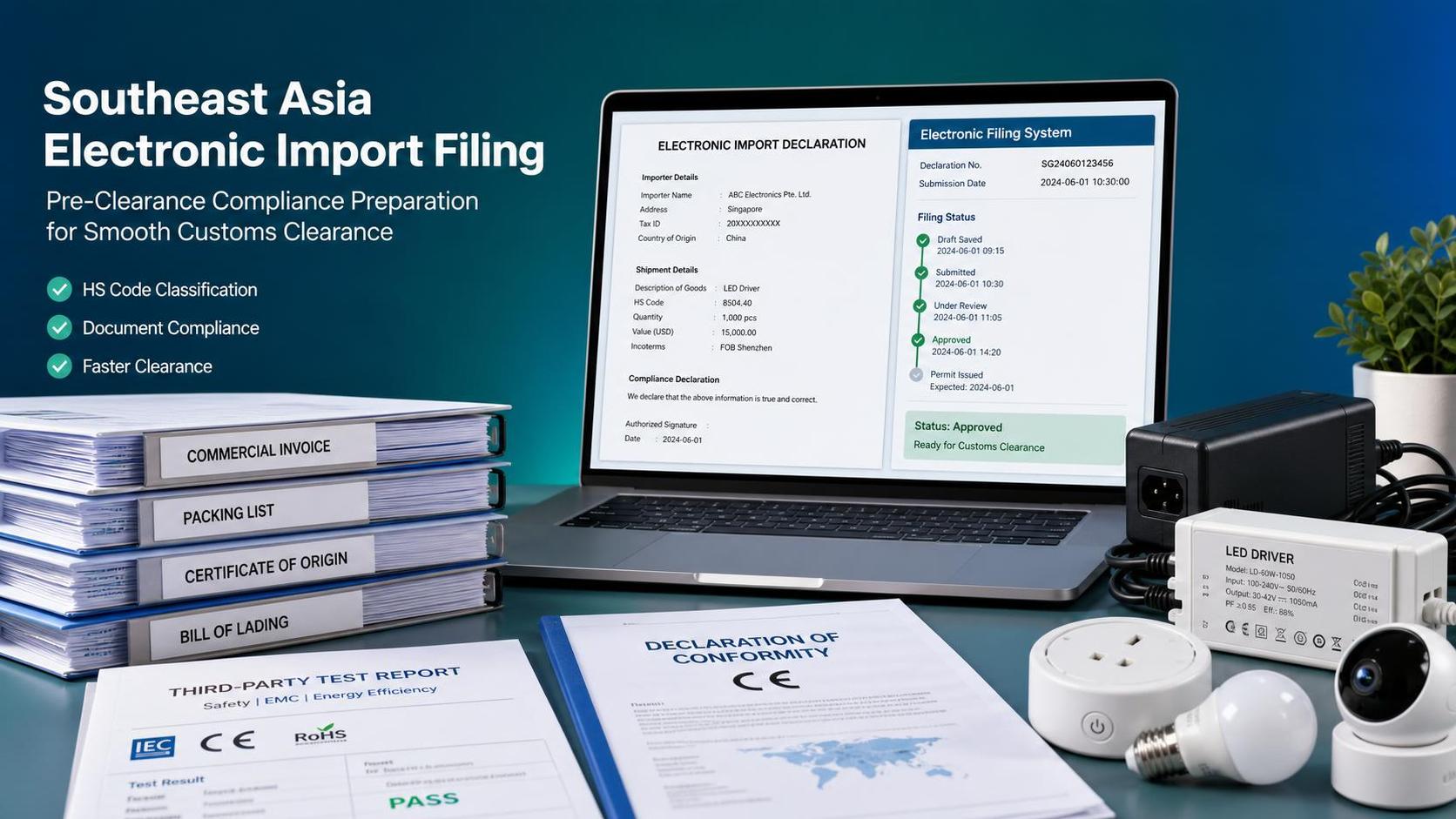
As of 2026-08-15, Vietnam, Indonesia, and Thailand have jointly issued a notice requiring finished electronic products imported into Southeast Asian markets to submit a conformity declaration for UL/IEC 62368-1 or the 61000 series before customs clearance, together with the number of a third-party test report. The change is directly relevant to exporters, importers, distributors, and compliance teams handling power adapters, LED drivers, and smart-device accessories, because it turns documentation readiness into a front-end trade requirement rather than a post-entry compliance task.
What the new filing requirement actually changes
The confirmed rule change applies to finished electronic products entering Southeast Asian markets, including power adapters, LED drivers, and smart terminal accessories. From 2026-08-15, the declaration must be submitted through a national electronic platform before clearance, and the filing must reference either UL/IEC 62368-1 or the 61000 series standard, along with a third-party test report number.
Failure to comply is stated to trigger either automatic return shipment or a 20% compliance deposit. That makes the measure materially different from a general technical notice: it links document submission, standard alignment, and border clearance into one process that affects whether goods can move at all.
Where the pressure lands across the supply chain
Exporters and direct traders will need cleaner pre-shipment files
For exporters shipping into the three markets, the most immediate impact is on order execution and customs handover. Product documents, conformity statements, and test report references will need to be aligned before goods leave the origin market. Analysis shows this is likely to tighten shipment timing, especially for orders that previously relied on downstream document completion.
Manufacturers must match product specs with the cited standards
For manufacturers, the key issue is not only whether a product is safe, but whether its technical file supports the specific standard route named in the notice. That affects product development, sample testing, change control, and documentation retention. If a model family spans multiple specifications, each shipment may need a clearer mapping between the exported item and the report number used for filing.
Buyers and channel partners may adjust acceptance rules
From an industry perspective, procurement teams and downstream distributors may begin requiring proof of filing readiness earlier in the purchasing cycle. That can affect supplier qualification, delivery commitments, and acceptance criteria. The rule therefore reaches beyond customs and into commercial onboarding, because buyers may not want goods that cannot clear entry formalities on time.
Testing and compliance service providers become part of the schedule
Testing laboratories and compliance consultants are also likely to be pulled closer to the front of the process. Their role is not changed by the notice itself, but their turnaround time and report format become operationally important because the filing depends on a third-party report number. That makes testing capacity, report traceability, and document consistency more relevant to trade execution.
What companies should review now
Check whether the product line falls within the stated scope
The notice expressly mentions finished electronic products, including power adapters, LED drivers, and smart terminal accessories. Companies should first verify whether the actual shipment item matches that scope, rather than assuming every electronic component is covered in the same way. The practical question is whether a given SKU needs the declaration before clearance.
Match the filing dossier to the referenced standard path
Companies should confirm whether their existing test reports and compliance statements are aligned to UL/IEC 62368-1 or the 61000 series, since the filing requirement names those standards specifically. Where documents exist in fragmented form, the risk is not only missing paperwork but also inconsistent technical references across the report, declaration, and commercial invoice set.
Build clearance timing into purchase and shipment planning
Because the filing is required before customs clearance, document readiness now affects the shipment clock. Exporters and buyers should review lead times for report retrieval, declaration preparation, and platform submission, especially for repeated orders with tight delivery windows. What deserves closer attention is whether current purchase plans leave enough room for pre-clearance review.
Track how enforcement language is applied in practice
The notice states the consequence for non-compliance, but the market still needs to observe how the filing platform, declaration review, and border handling work in daily execution. Businesses should watch for any further official wording on submission format, document validation, and the handling of discrepancies between the declared standard and the test report.
How to read this signal right now
Observably, this is best understood as an execution signal rather than a loose policy discussion. The rule is tied to a specific start date, a named filing channel, named technical standards, and explicit border consequences. That gives it a clearer operational character than a general compliance statement.
At the same time, it is still important to observe how the measure is implemented across the three markets, especially any follow-up wording on filing practice, report references, and acceptance at clearance. For now, the more prudent reading is that the region is raising the compliance bar at the border, and companies serving these routes should treat document readiness as part of trade execution, not a back-office afterthought.
Why this matters for market participants
This development matters because it connects product compliance, customs clearance, and customer onboarding in one step. For Chinese electronics exporters in particular, the issue is less about abstract regulatory change and more about whether goods can move on schedule and whether buyers will accept the shipment file as complete. The appropriate conclusion is not that market access has closed, but that access now depends more visibly on pre-clearance conformity proof.
Source note and follow-up items
This article is based on the title, event date, and summary provided by the user. No specific official source link was included in the input, so the underlying notice should still be verified against the relevant official announcement, regulatory authority publication, customs or trade authority updates, standard-body documents, industry association notices, and authoritative media coverage.
What still needs continued monitoring is the detailed filing wording, platform operation rules, how the standards are applied to specific product categories, whether any supplementary guidance is issued, and how exporters and importers adapt their document and delivery workflows in practice.